

The leaves of a tree, a sprout emerging from among the stones, a fruit on our table… Risale-i Nur teaches us to recognize the artistry and mercy of our Lord in these everyday things we see.
There is a tree we pass by every day. We mention its location when giving directions, and in the summer we seek shelter in its shade. Yet we often fail to notice when it begins to bud in the spring. We have become so accustomed to the tree that we do not pause to consider its very presence. Yet the fact that this trunk grew from a tiny seed, and that its branches are laden with fruit, is still a marvel.
Bediüzzaman frequently draws our attention to such familiar examples in the Risale-i Nur. He places a seed before us and leads us to the foot of a tree. We begin to reconsider the things we’ve grown so accustomed to that we no longer see them. As we wonder how a leaf is created and what purpose it serves, we come to recognize the knowledge and power of its Creator. Contemplation leads us toward knowing our Lord, starting from the work we see.
An Invitation to Contemplate Creation
The Qur’an is the guide for this perspective. In verses 190 and 191 of Surah Al-Imran, our attention is drawn to the creation of the heavens and the earth, and to the alternation of night and day. As those endowed with reason reflect on these matters, they remember Allah and say, “Our Lord! You did not create this in vain.” [1] Seeing the wisdom in the universe directs them toward the Creator. Their thoughts turn into prayer.
The Risale-i Nur follows this path of contemplation opened by the Qur’an. While describing the creation of a flower, it leads one to reflect on the art evident in its color and fragrance, its relationship with the bee, and its place within life on earth. The flower reveals a knowledge and wisdom that transcend itself. Thus, a window opens from this small being to the entirety of the universe.
Reading the Book of the Universe
When we pick up a letter, we look at the paper and the writing. To read it, however, we must understand what the words are saying. The comparison of the universe to a book in the Risale-i Nur is also an invitation to read the meaning within all things. Viewing objects as works that reveal their Creator is called “literal meaning” (mana-yi harfi). Bediüzzaman describes this perspective in the *Mesnevi-i Nuriye* as follows:
“When one looks at a blessing, the Bestower (Mün’im) should come to mind; when one looks at art, the Artist (Sâni’) should come to mind; and when one considers causes, the True Cause (Müessir-i Hakikî) should come to mind. [2]
‘The Bestower’ is the One who grants blessings; ‘the Creator’ is the One who creates through art. The ‘True Cause,’ however, refers to the true source of influence behind the causes. We know the tree from which the fruit in our hand grew. We also remember our Lord, who has bestowed it upon us as sustenance. In the harmonious interplay of the tree, the soil, and the water, we see His knowledge and mercy.
The Twelfth Word also illustrates how this perspective is reflected in our language: “How beautifully it is made, how beautifully it points to the beauty of its Creator!” [3] The admiration we feel for a beautiful flower serves as a means of love for Allah, who created it so beautifully. As we gaze at the flower, our hearts, too, partake of this beauty.
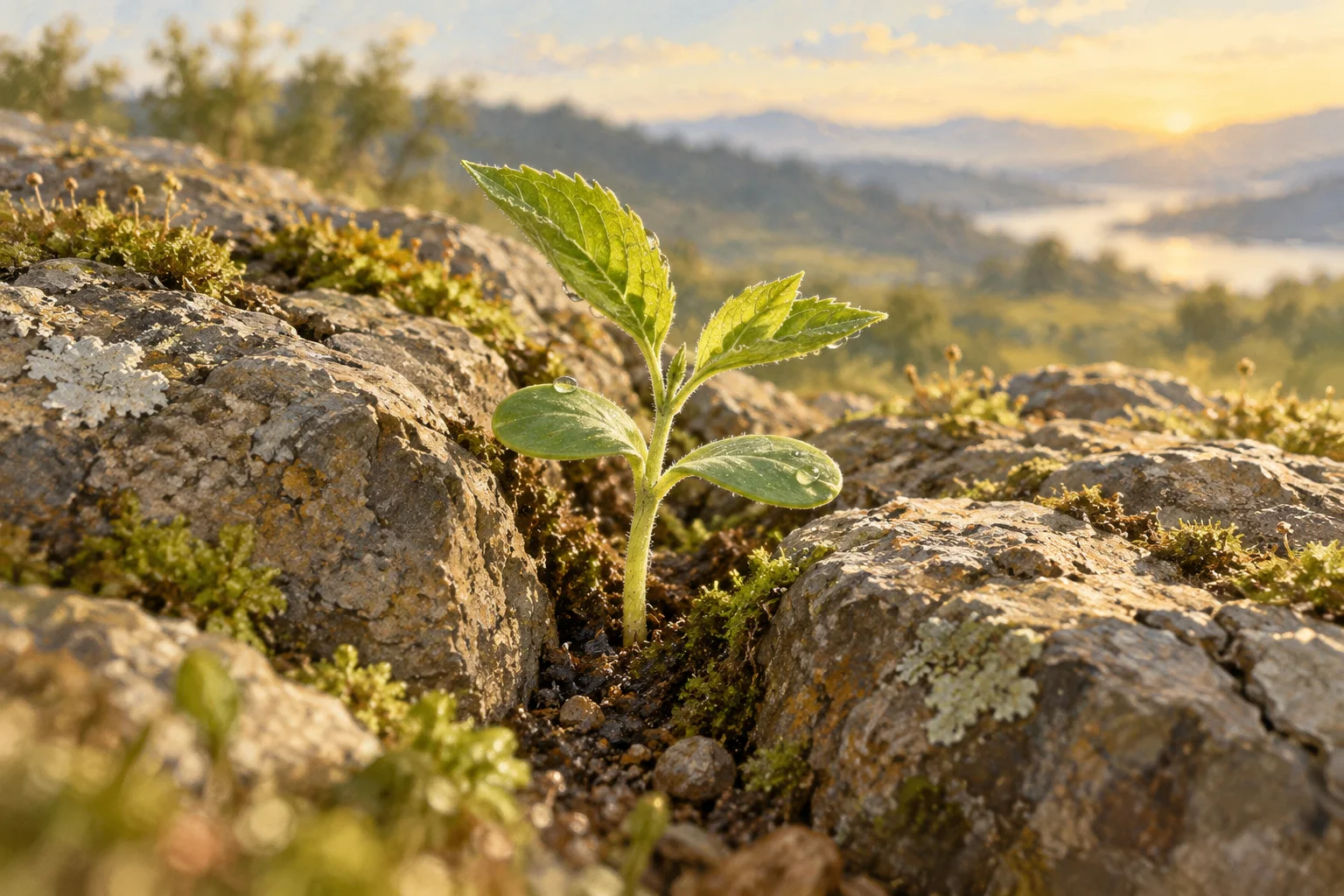
A sprout rising from among the stones. Illustrative image.
Reflections on a Sprout
Let us bend down and look at a sprout emerging from among the stones. Its stem is so delicate it might break between our fingers. Its roots, however, push their way through the hard soil. The First Word highlights the contrast between this apparent fragility and the work it accomplishes:
“The roots and veins of every plant, tree, and blade of grass—as soft as silk—say, ‘Bismillâh’; they pierce through the hard stone and soil.” [4]
The “Bismillâh” here describes how beings carry out their work in the name of Allah, through the strength He grants. The sprout does not send its roots into the soil based on its own knowledge. It is created, nourished, and nurtured in a way suited to its needs. Bediüzzaman, pointing to that slender root, calls us to reflect on the power behind it.
Learning how a plant grows deepens this contemplation. As we investigate how water is transported from the root to the leaf and how nutrients are produced in the leaf, we come to know the subtleties of creation more intimately. When we observe this process through the lens of the lesson taught in the Risale, we remember our Lord, who governs through His knowledge and will behind all causes. What we know fuels our sense of wonder.
The truth obscured by habit
If we were to witness a tree blooming for the very first time in the world, we would likely be unable to tear our eyes away from it. Yet when it repeats every spring, we regard the same event as ordinary. In the Thirteenth Word, Bediüzzaman draws attention to the “veil of custom and familiarity” that covers all things. [5] Familiarity is this aspect of habit that distances us from wonder. Knowing how something works is different from becoming accustomed to it; sometimes the reason we think we know something is simply that we have seen it so often.
The Qur’an lifts this veil and opens up “an inexhaustible treasure trove of knowledge for the mind.” [5] In other words, it presents an endless treasure of knowledge to our minds. The rain that everyone sees, the sun that rises every day, and the nourishment of a newborn are all presented anew to our attention. Encountering them again does not diminish the artistry in these events. Every leaf a tree produces this spring has been newly created. Yet, because we saw the same thing last year, we may fail to pay attention to what is happening this spring.
From Contemplation to Gratitude
One of the most immediate expressions of this thought is found at our table. When we pick up an apple, we reflect on how a tree, the soil, the rain, and the sun all worked together for it to grow. Our Lord, who orchestrates all of this in a way that meets our needs, has also given us a tongue with which to savor that fruit. As we become aware of this blessing, a sense of gratitude awakens in our hearts toward the One who bestowed it.
In the First Word, the connection between remembrance (zikr), gratitude (şükür), and reflection (fikir) is described within this context of closeness. Beginning with the remembrance of Allah’s name as we partake of a blessing, concluding with praise to Him, and reflecting in between on how that blessing is a manifestation of His power and a gift of His mercy—these elements complement one another. [4] Contemplation thus finds its place throughout the day.
Appreciating the value of a blessing is also reflected in our behavior. Bediüzzaman states in the Treatise on Gratitude: “The measure of gratitude is contentment, frugality, acceptance, and satisfaction.” [6] Here, “mikyas” means “measure.” Taking only what we need at the table, not wasting what is left over, and not looking down on what has been given to us are some of the ways our gratitude manifests in daily life.
Next time we pass by that tree, we can pause for a moment. Let’s look closely at one of its branches and consider how its needs are being met. Let us not forget ourselves either. Our Lord, who nourishes us with that tree’s fruit, reveals Himself to us through the blessings He bestows. When we recognize this generosity, we feel the meaning of the “Alhamdulillah” that flows from our lips even more deeply.
Sources
[1] The Holy Qur’an, Surah Al-Imran, verses 190–191.
[2] Bediüzzaman Said Nursi, Mesnevi-i Nuriye, Katre, Introduction.
[3] Bediüzzaman Said Nursi, The Words, Twelfth Word, First Principle.
[4] Bediüzzaman Said Nursi, The Words, The First Word.
[5] Bediüzzaman Said Nursi, The Words, Thirteenth Word, First Station.
[6] Bediüzzaman Said Nursi, Mektubat, Twenty-Eighth Letter, Treatise on Gratitude.
The images are representative illustrations generated by artificial intelligence for this article.