
The life of Denizli-born teacher Hasan Feyzi Yüreğil can be reread through a family photograph and letters travelling back and forth between two cities.
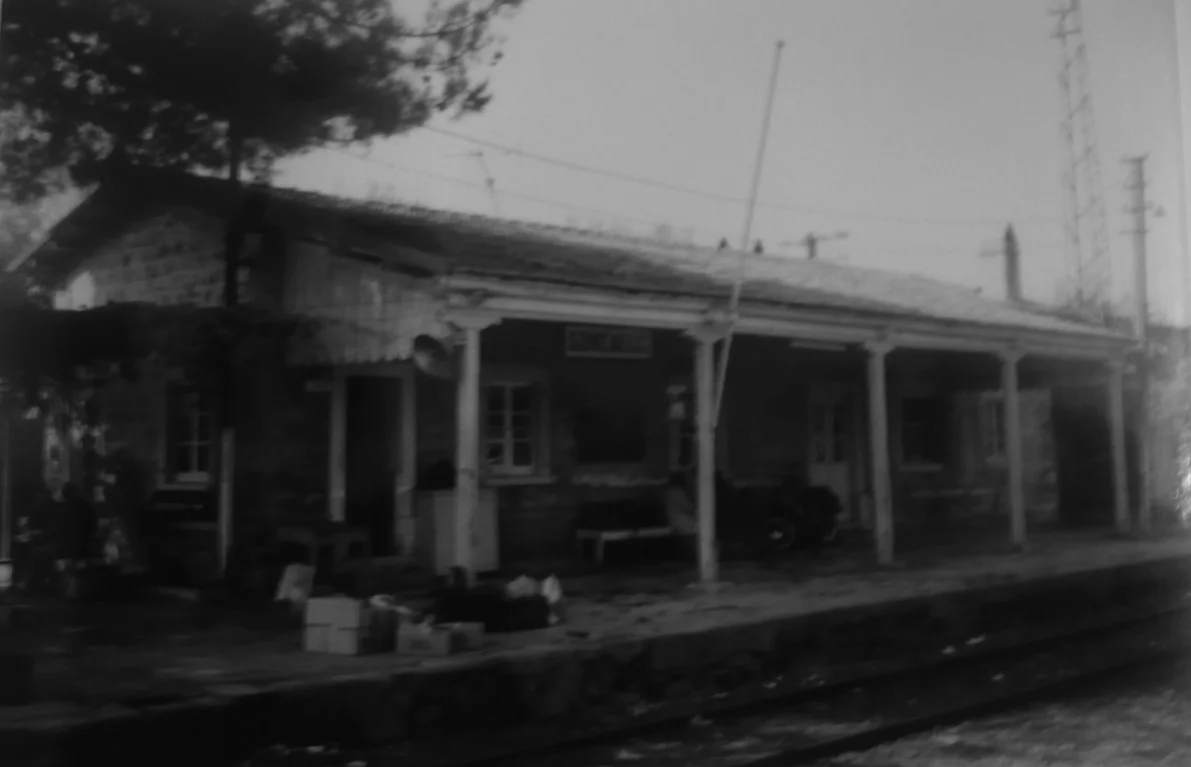
Goncalı station. Three Feyizli Nur, p. 174.
Late July 1944. Bediuzzaman Said Nursi arrives at Goncalı station to leave Denizli. Among those accompanying him is Hasan Feyzi Yüreğil, a teacher from Denizli. Necmeddin Şahiner recounts the farewell through a small detail. After Nursi has boarded the train, Yüreğil places in his lap a poem he had written beforehand. He had titled the poem “I Told You This as I Was Leaving Your Presence.”
Nursi’s arrival in Denizli had also begun with a journey. In 1943, he was arrested in Kastamonu and sent to Denizli, where he and his students were tried on account of the Risale-i Nur. While the trial was under way, Yüreğil had no opportunity to meet Nursi. A court clerk delivered to him the treatises being examined. Yüreğil first came to know Nursi through his writings. After his release, he visited him at the hotel where he was staying.[1]
After the farewell at Goncalı, correspondence took the place of meetings. Many things reached Emirdağ by letter, from who in Denizli was reading and making copies of the Risales to the greetings from the household. The everyday life of the city, too, found its way into a few pages. Yet the story in Denizli of the man who wrote those pages had begun long before the farewell at the station.
A family photograph in Honaz
Şahiner’s book contains a photograph dated 9 October 1934. Hasan Feyzi is seated on a chair, holding one of his children in his lap. His other three children stand around him. The caption says that he was then a teacher in Honaz. Taken about ten years before the farewell at Goncalı, this photograph allows us first to see him alongside his children and during his years as a teacher.
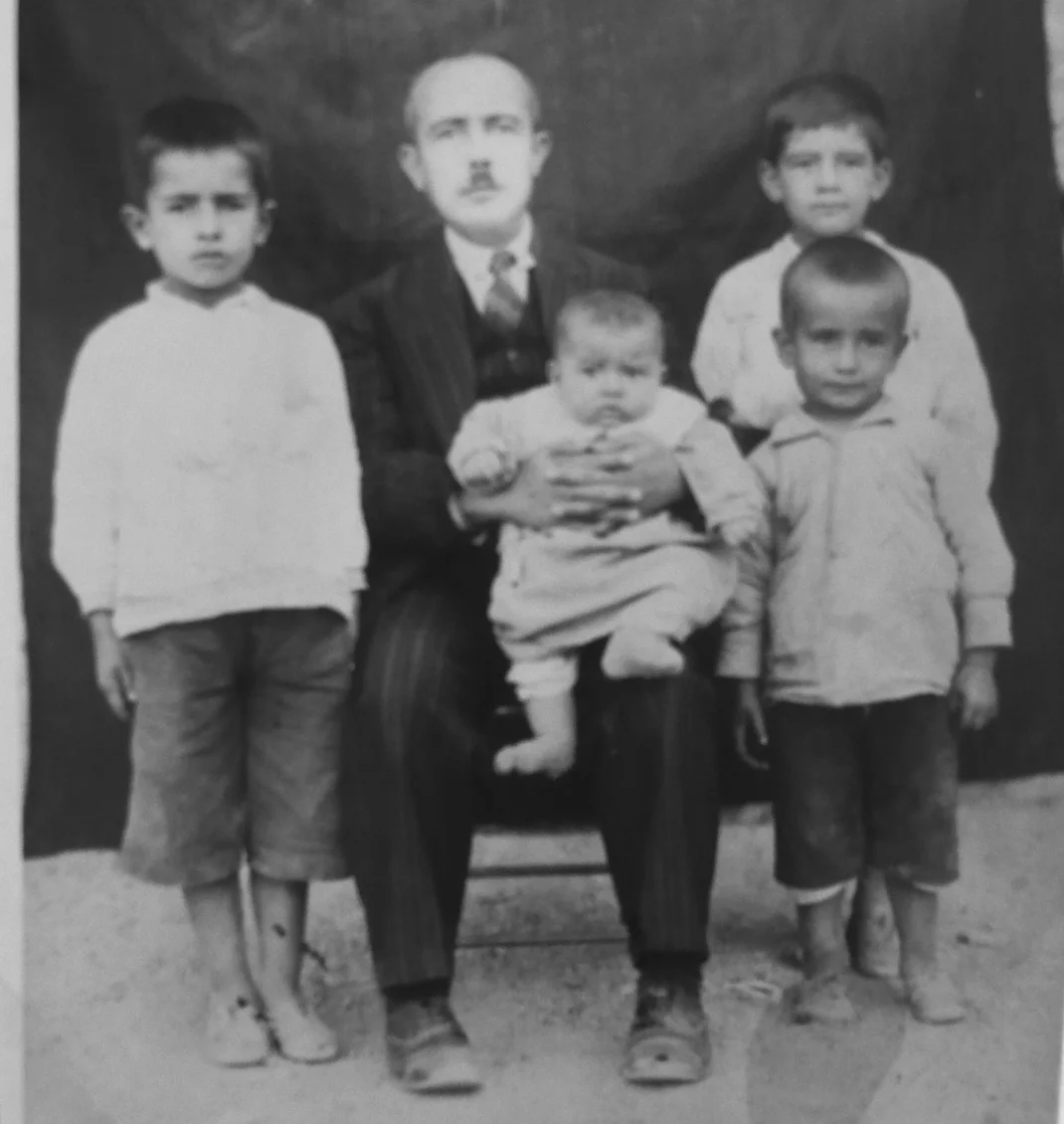
Hasan Feyzi Yüreğil and his four children, 9 October 1934. Three Feyizli Nur, p. 170.
Hasan Feyzi, born in 1895 in the village of Yüreğil in Acıpayam, taught not only in Honaz but also in places in Denizli such as Şamlı, Gözler and Göveçlik. In the recollections of his son Fikret, before he met Bediuzzaman he was known as “Teacher Hasan Efendi of Yüreğil.” In the biographical notes left by Muslihiddin Sönmez, another aspect of him emerges alongside his teaching. He had studied under Üsküplü Ferid Efendi and held gatherings in Denizli within the Melâmî tradition.
Nurettin Topçu, too, came to know Yüreğil through Sönmez. In the recollection he shared with Şahiner, he says that they met frequently in those days. Topçu remembers him for his affection, and particularly for his deep devotion to Bediuzzaman. This testimony allows us to see him not only through the poems he wrote to Nursi, but also as someone with whom people met in Denizli and whose conversations they remembered.
A visit recounted by his son Fikret gives us a glimpse of this circle from within the home. His father sent him to take a packet of tea to Nursi, who was staying at a hotel. Fikret, who worked as a cobbler, also brought back a shoe that needed repairing. These are the details of those days, remembered by a child, which were otherwise associated with the trial and surveillance.
Letters from Denizli
A lengthy letter Yüreğil sent to Nursi received an unusual response in the Emirdağ Addendum. Nursi valued the reflections on the Risale-i Nur of someone who had taught for many years. He said the letter also showed what people reading the Risales in Denizli thought. He then noted that he had removed or altered some of the praise directed at him personally in the text. He took Yüreğil’s writing seriously and also considered the wording in which the letter would reach its readers.
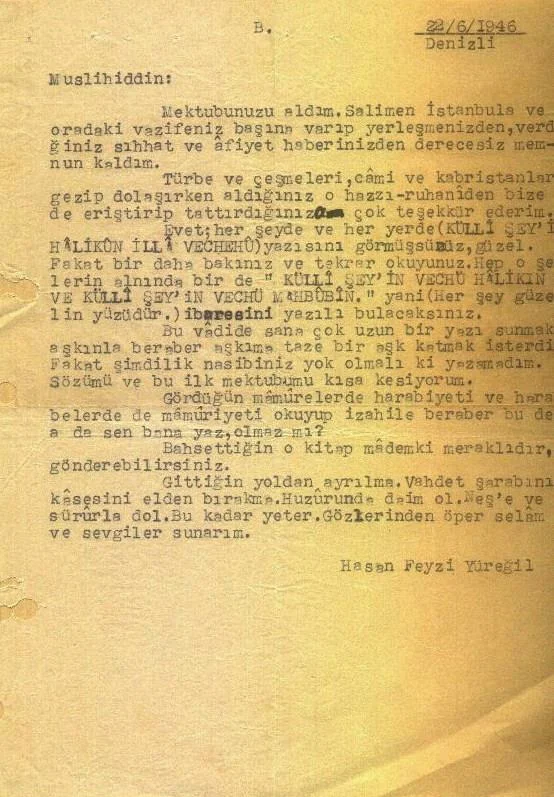
Hasan Feyzi Yüreğil’s letter to Muslihiddin Sönmez, 22 June 1946. The Elders Speak, vol. 6, p. 68.
Another letter begins with only the recipient’s name. It opens, “Muslihiddin.” In this letter, written from Denizli on 22 June 1946, Yüreğil is pleased that Sönmez has arrived safely in Istanbul. Sönmez had told him about the shrines, fountains, mosques and cemeteries he had visited. Yüreğil asks his friend to look again at the places he had seen and write to him about what he noticed in those buildings. He is brief. At the end of the letter, he replies about a book and sends his greetings to his friend.
In his letter to Nursi, Yüreğil speaks on behalf of a circle of readers in Denizli; here, he tries to see Istanbul through the eyes of a friend. His teaching is also discernible in this short typewritten page. He leaves his correspondent with a question that invites him to reconsider what he has observed, then awaits his reply.
Yüreğil’s poems, too, sometimes address a reader in this way. In a poem included in The Life of Bediuzzaman, he writes, “Read well! In every particle there is a meaning that surges forth.” In his letter, he speaks to the friend he invites to walk through Istanbul once more; in his poem, he addresses a reader whom he urges not to pass hastily over what they see. In both texts, attention begins by pausing a little longer over what is seen.
A letter awaiting its opening in Emirdağ
When Yüreğil heard that Nursi had prepared a will in Emirdağ, he took up his pen again. Should he read the will as a sign of departure? In his letter, he returns to this question again and again, and writes, “Send us word.”[1] The poem at Goncalı had been left behind after a farewell. This letter, by contrast, was written out of anxiety over a farewell that had not yet taken place.
On 13 November 1946, Hasan Feyzi Yüreğil passed away in Denizli. Muslihiddin Sönmez records that he had suffered a brief chest illness in his final days. He was buried in İlbadı Cemetery, near Hafız Ali. This time, the letter that reached Emirdağ from Denizli carried the news of Yüreğil’s death.
In his letter of condolence, Nursi writes that, contrary to his usual practice, he held the letter in his hand for an hour and a half and could not open it. He then gives those left behind a concrete task. He asks them to append some of Yüreğil’s writings to the end of the treatises, so that these texts may continue to reach readers. He speaks again of Yüreğil’s teaching, recalling the part he had played in directing young people towards the Risales as a teacher familiar with schools and the subjects taught there.
As the train departed from Goncalı, a poem left Yüreğil’s hands. Two years later, the letter awaiting its opening in Emirdağ stands at the other end of that farewell. In the pages in between, we hear the voice of a poet: the teacher who asks his friend in Istanbul to write again about what he has seen, tells of readers in Denizli, and awaits word as departure draws near.
On the occasion of the 80th anniversary of his passing, we remember Hasan Feyzi Yüreğil with prayers for mercy.
Sources
Necmeddin Şahiner, Three Feyizli Nur. Şahdamar Publications, 2009, pp. 167–178 and 189–190.
Said Nursî, Emirdağ Addendum, letter 50. IIKV edition of the collection.
Said Nursî, Letter on the death of Hasan Feyzi. Risale Online edition, pp. 339–341.
Ömer Özcan, The Elders Speak, vol. 6. Muslihiddin Sönmez’s testimony and a copy of the letter, p. 68.
[1] IIKV, We Remember Hasan Feyzi Ağabey with Prayers for Mercy. 13 November 2019. Excerpt from the letter concerning the will.
Alparslan Açıkgenç, Said Nursi. TDV Encyclopaedia of Islam, the Denizli trial and transfer to Emirdağ.
Mustafa Oral, Ali Fikret Yüreğil’s recollections. Yeni Asya, 2019.
The Life of Bediuzzaman, Hasan Feyzi’s poem. IIKV edition of the collection, p. 491.
Interview with Nurşen Yüreğil. Yeni Asya, 24 February 2017.
Related content

Between Need and Want
A discount label can make something we had not considered seem like a need. The Treatise on Economy teaches us to find moderation in our spending and to appreciate the value of blessings.

A Commentary Written on the Front
The story of the composition of İşârâtü’l-İ’câz, from lessons in Van to the front

Contemplating Nature
The leaves of a tree, a sprout emerging from among the stones, a fruit on our table… Risale-i Nur teaches us to read our Lord’s art and mercy in these things we see every day.