
The story behind the writing of *İşârâtü’l-İ’câz*, from the lessons in Van to the front lines
On the Eastern Front of World War I, Said Nursî, who was commanding his volunteers, was having a commentary written. The books he could consult were not with him. Whenever the war permitted, he would reflect on verses of the Qur’an and have his student, Molla Habib, record the insights that came to his heart. A significant portion of *Isharat al-I’jaz* was authored under these conditions. [1]
His engagement with exegesis under these conditions speaks to the value Bediüzzaman placed on the Qur’an. He did not wait for all difficulties to pass before working. He followed in his own life the principle he recalled at the beginning of his work:
“It is not permissible to completely abandon something simply because it cannot be fully attained!” [2]
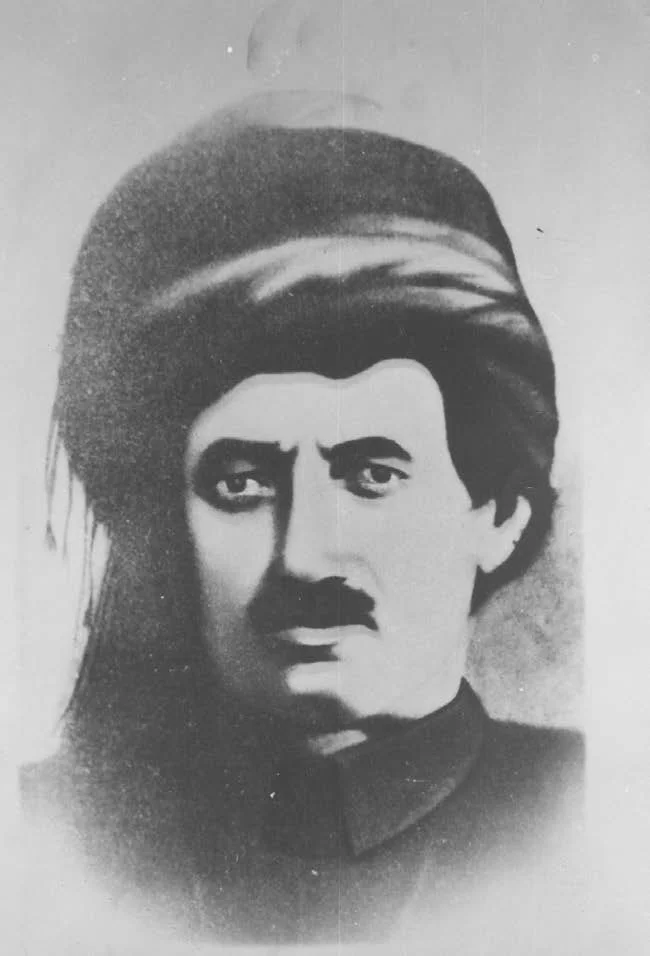
A portrait mentioned in *Tarihçe-i Hayat* as dating from the end of World War I
From classes in Van to the front lines
Before the war, Said Nursî, who was teaching his students in Van, was working toward the establishment of the Medresetü’z-Zehrâ, which he wished to found in the East. He envisioned this institution, whose foundation was laid on the shores of Lake Van, as a place where religious and scientific disciplines would be taught together. The war cut this endeavor short. The teacher and students who had been studying together at the Horhor Madrasa soon found themselves on the front lines.
The exegesis studies that had begun during the Qur’an classes in Van were also carried to the front lines along with them. The insights that Bediüzzaman recorded whenever he found the opportunity in the mountains of Erzurum and Pasinler were a continuation of these lessons. [2]
The Lines Written by Molla Habib
Molla Habib, one of Bediüzzaman’s earliest students, holds a special place in the composition of *Isharat al-I’jaz*. *Tarihçe-i Hayat* describes this collaboration between the teacher and his student as follows:
“Sometimes on the front lines, sometimes on horseback, and sometimes when they took cover; he would speak, and Molla Habib would write.” [1]
The front line is the forward battle line where one comes into direct contact with the enemy. Bediüzzaman, explaining the work’s concise and intense narrative style, says, “At that time, there was no room for explanation.” [3] His consideration of his students’ scholarly level and his focus on the subtle connections of meaning within the verses also played a role in this narrative style. It might be necessary to dwell at length on a single sentence in the book.
Delving Deep into a Verse
In *Isharat al-I’jaz*, the structure encompasses the placement of words within a verse and the connections of meaning they establish with one another. *I’jaz*, meanwhile, refers to the Qur’an’s miraculous expression, which cannot be replicated. Bediüzzaman explains his purpose as “to elucidate the signs and symbols of i’câz pertaining to the Qur’an’s structure, wording, and phrasing.” [4]
The phrase “Iyyâke na’büdü” in the Fâtiha is a close example of this. Why do we speak in the plural when saying, “We worship only You”? In exegesis, it is explained that this phrasing points to the worship of all believers in the Oneness of God, as well as all beings in the universe, together with the limbs and particles of our bodies. As the servant turns toward his Lord, he finds himself within a vast community of worshippers. [4] A verse we read every day takes on a deeper meaning in our hearts the more we reflect on its significance.
A boundary observed even in war
The advance of Russian forces brought Said Nursî and his students to Van. Although they wished to continue their defense at Van Castle, they withdrew to Vastan at the insistence of Governor Cevdet Bey. While the people were heading toward Bitlis, they held off the Cossack cavalry to ensure the safety of the families left behind. By climbing a high hill at night to give the impression that reinforcements were arriving, they bought people time to evacuate. [1]
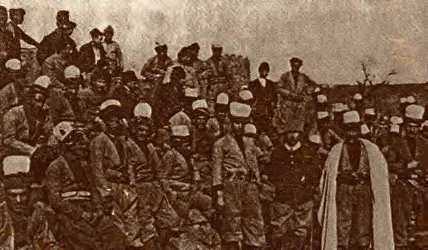
A photograph of the militia published in the “Keçe Külâhlılar” section of *Nurlu Yıllar*
In *Tarihçe-i Hayat*, it is recounted that he ordered the soldiers, “Do not harm these children!” regarding the Armenian children gathered at that location, and then ensured they returned to their families. [5] His protection of the rights of the innocent amid armed conflict demonstrates his commitment to the Qur’an through his actions as well.
From the Defense of Bitlis to Captivity
Molla Habib was martyred in Vastan. After his passing, the pages of the exegesis carried memories of the lessons they had shared and the days spent on the front lines. During the defense of Bitlis, Said Nursî went with volunteers toward Nurşin and ensured the rescue of the cannons brought from Muş. Defending the city for a few more days allowed the people to retreat. [5]
He lost his nephew Ubeyd and many of his students in the fighting. Wounded and with a broken leg, he waited in the water and mud with his surviving students. Although he asked his students to save themselves, they refused to leave him. Eventually, they were taken prisoner by the Russians. [5] Their journey into captivity led them to Kologrif and Kostroma. There, too, he continued to teach among the prisoners.
Bediüzzaman, later reviewing the passages in *Işarat al-I’jaz*, referred to them as “those tattered phrases written and clothed among the martyrs.” [2] While reading the lines penned by Molla Habib, one must also recall the days in which those lines were written.
A Commentary Left for the Future
When he returned to Istanbul in 1918, he had years of war and captivity behind him. A June 25, 1918, article in the Tanin newspaper announced the arrival in the city of Said Nursî, who had fought on the Caucasus front alongside his students and been taken prisoner by the Russians. [8] *Isharat al-I’jaz* was also published in Arabic in Istanbul that same year. [6] The witticisms recorded on the front could now be read in book form.
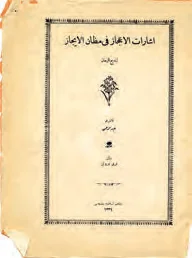
The title page of an old edition of *İşârâtü’l-İ’câz*
Bediüzzaman viewed this work as a model and source for a comprehensive exegesis to be prepared in the future. He considered it essential for scholars specializing in different fields to collaborate and benefit from one another’s ideas. He clearly stated that the scope of understanding the meanings of the Qur’an that a single person could encompass with their knowledge was limited. [2]
Later, expressing his hope that *Isharat al-I’jaz* and the other treatises of the *Risale-i Nur* would serve as sources for such a work, he said, “May a fortunate committee write such a Qur’anic commentary in the future, insha’Allah.” [3] He viewed his own efforts as part of a scholarly service that would continue after him.
The statement in a note regarding the Turkish translation of the work—“Even a speck of the Qur’an is of great value”—helps us understand this perspective. [7] Opening *Isharat al-I’jaz* today and reading a passage from Surah al-Fatiha is a starting point for understanding the purpose of that effort. We can pause a little longer to reflect on the meaning of the words we repeat every day in our prayers.
Sources
[1] Bediüzzaman Said Nursî, *Tarihçe-i Hayat*, Early Life, Command of the Volunteer Regiment.
[2] Bediüzzaman Said Nursî, *Isharat al-I’jaz*, *Ifat al-Meram*.
[3] Bediüzzaman Said Nursî, *Isharat al-I’jaz*, “Warning.”
[7] Bediüzzaman Said Nursî, *Isharat al-I’jaz*, Footnote, Third Point.
[8] Tanin, June 25, 1918, issue 3428, “Muvâsalat” article.
Visual sources: History of Life; The Enlightened Years: The Life of Bediüzzaman Said Nursî, His Students, and the Years of Composition and Publication of the Risale-i Nur.
Related content

Contemplating Nature
The leaves of a tree, a sprout emerging from among the stones, a fruit on our table… Risale-i Nur teaches us to recognize the artistry and mercy of our Lord in these everyday things we see.